


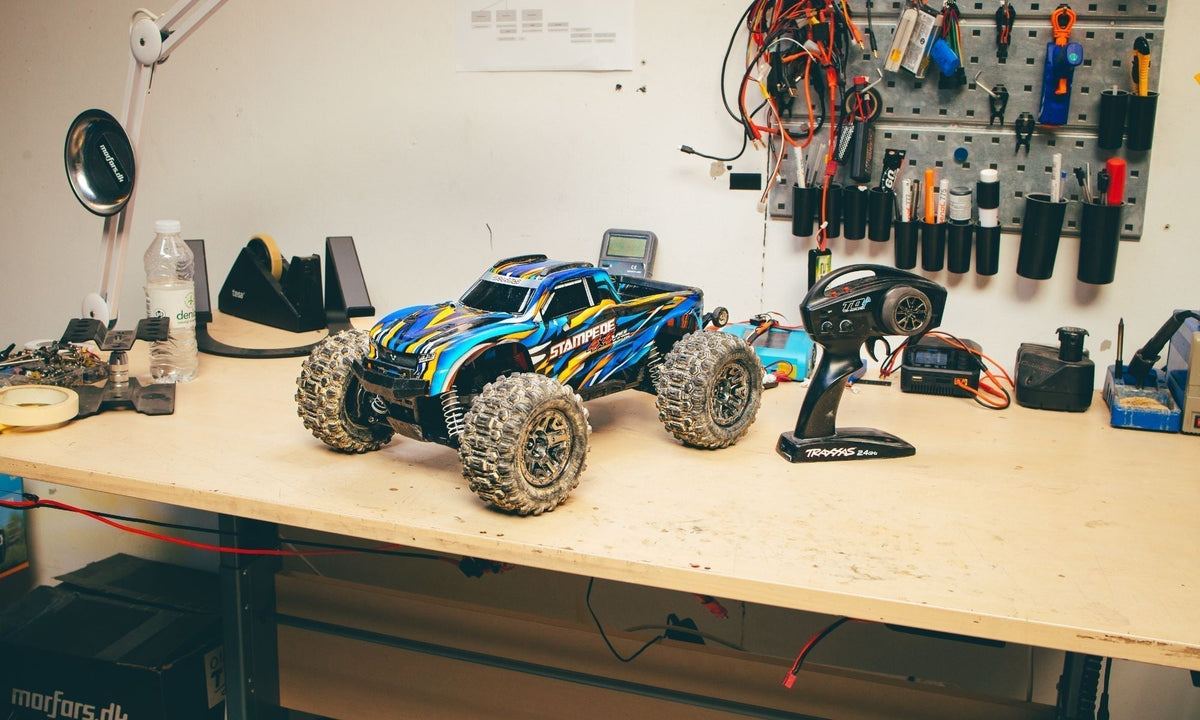
How to Maintain Your RC Car
Your RC car is meant for adventure. Take it out on gravel, dirt, grass, and asphalt, and let it come home showing signs of a great ride.
However, dirt, grass, moisture, and vibrations can settle into your car. A bit of maintenance after your ride can make a big difference in both handling and the longevity of its parts.
Luckily, it doesn't have to be complicated. Disconnect the battery, remove the worst of the dirt, dry the car, and check for anything loose or sounding off.
This guide goes over how to clean and maintain your RC car, what to watch out for, and how to care for the battery.
Quick Checklist After Every Run
- Disconnect the battery from the car.
- Remove dirt, grass, and pebbles from the undercarriage and wheels.
- Dry the car thoroughly if it's been in water, mud, or wet grass.
- Check wheels, wheel nuts, and visible screws.
- Listen for new clicking, crunching, or rattling sounds.
- Let a warm battery cool down before charging.
Why Maintain Your RC Car?
An RC car is full of moving parts. Wheels, bearings, drive shafts, differentials, gears, steering, and suspension all work continuously while the car runs.
At the same time, the car faces vibrations, dust, pebbles, grass, and sometimes water and mud. This might cause a screw to loosen, grass to wrap around a shaft, or moisture to stay around bearings and other metal parts.
This isn't necessarily a sign of trouble. It's all part of owning an RC car that gets used.
At Morfars, we focus on cars that can be repaired and maintained. That's why we also have spare parts for the cars we sell, so a worn or broken part doesn't mean replacing the whole car.

1. Start by Removing Dirt and Grass
After a typical run, the first thing you should do is disconnect the battery from the car.
Then you can start with the simple cleaning. If the car has only been on dry gravel, asphalt, or grass, there's often no need to soak it. An old brush or soft brush is perfect for clearing dirt, dust, and grass from the undercarriage and around the suspension.
Compressed air can also be effective for loose dirt, but be careful to protect your eyes when blowing away pebbles and debris.
Pay extra attention to the wheel axles. Long grass, hair, and similar can twist around the axles, creating extra resistance. This can make the motor and drivetrain work harder than necessary.
Watch the Video: Cleaning Your RC Car
If you want to see the cleaning process in action, we show in the video how to remove dirt and grass from the car after a run.
See the cleaning in practice by watching our video here.

2. Has the Car Been Wet or Muddy?
First, it's important to know what type of car you have.
Just because a car has water-resistant electronics doesn't mean the whole car can be treated as waterproof. The degree of water protection varies from model to model, so always check the specs and manual for your specific car.
If the car is designed for wet conditions, a more thorough cleaning may be needed. Use a brush and possibly a mild detergent to loosen the mud. If the car can be rinsed with water, use low water pressure.
Avoid a pressure washer.
High water pressure can push water and dirt into areas you don't want it, like around the transmission, differentials, bearings, and electronics.
When the car is clean, it needs to be thoroughly dried. Use a cloth, a brush, and possibly compressed air to remove water from crevices and joints. Let the car sit in a dry place until it's completely dry.
It's not just about the body looking dry. It's particularly the moisture around screws, bearings, shafts, and other metal parts that you want to eliminate.

3. Check the Wheels Before You Pack It Away
It's worth spending 30 extra seconds on the wheels. Grab each wheel and feel if anything seems unusually loose. Check for grass around the axles, damage to the tires, and loose wheel nuts.
Vibrations during a run might gradually loosen screws and nuts. This doesn't mean you should tighten every screw as hard as possible after each drive. Quite the opposite.
Check if anything is loose, and tighten it properly. Over-tighten small screws in plastic parts, and you might ruin the thread.
A good set of screwdrivers and wrenches in the right sizes makes the job easier and reduces the risk of damaging the screws.
4. Inspect the Steering and Suspension
While you have the car out, move the wheels from side to side, and gently press the car down on the suspension.
The steering should move freely, and the wheels should respond normally to the transmitter. If the car suddenly steers oddly, the servo is making strange noises, or there's much more play than before, it’s worth checking the cause before continuing to drive.
The same goes for the shock absorbers. If your car has oil-filled shocks, they may need service or new oil over time. Don’t just pick random oil; the right viscosity depends on the car, the shock, and the setup you desire.
5. Keep an Eye on the Drivetrain
No need to disassemble the differentials after every run. But learn how your car usually sounds.
If the car suddenly starts crunching, rattling, or clicking during acceleration, or if one or more wheels aren’t driving as usual, you should stop and inspect the car.
It might be something as simple as grass around an axle or a loose screw. But it could also be a worn bearing, a damaged gear, or something in the differential.
Continuing to drive with a damaged gear might turn a small repair into a more significant one. When servicing or repairing the transmission or differentials, it's a good time to check the gears for wear.
Always follow the manual for your specific model when servicing the drivetrain. Not all gears and mechanical parts are lubricated the same way.

6. The Battery is Also Part of the Maintenance
One of the most important steps happens after the car has stopped: Disconnect the battery from the car.
The battery should only be connected when the car is in use. Let the battery cool down if it's warm after a run before charging it.
Batteries shouldn't be stored completely discharged. If you use LiPo or Li-ion batteries, it's essential to follow the instructions for the battery and charger. If your charger has a storage function, it can bring compatible batteries to an appropriate voltage for long-term storage.
During charging, the battery should always be supervised. It shouldn't be left in the charger once the charging is finished.
Read important information about using, charging, and storing batteries
Need a Charger with Storage Mode?
Charger C22 plugs directly into a standard outlet and features storage mode. It can be used with compatible LiPo, Li-ion, and LiHV battery packs with 2-3 cells.
Check out Charger C22 with storage mode
If you’re using Traxxas batteries with iD connectors, the EZ-Peak PLUS is the easy solution. The charger recognizes compatible Traxxas iD batteries and has a storage function for LiPo batteries.
Check out Traxxas EZ-Peak PLUS
If you're uncertain about battery type, connectors, or chargers, don't guess. There are many combinations of voltage, battery chemistry, and connectors.
7. Store the Car Clean and Dry
Once the car is cleaned and checked, don't pack it away wet in a box or bag.
Find a dry spot where the car can sit without direct sunlight or extreme temperature changes. If the car has been very wet, allow extra time to dry.
This is especially true after runs in mud, water, or wet grass, where moisture can hide around bearings, screws, and inside smaller joints, even if the surface appears dry.
How Often Should You Maintain Your RC Car?
It completely depends on how you use it. A car that has driven for 15 minutes on dry asphalt doesn't need the same treatment as a monster truck that's spent an hour in wet grass and mud.
That's why it's rarely useful to say the car needs service every fifth run. Instead, use the car and conditions as a guide:
- After Each Run: Remove the worst dirt, disconnect the battery, and look for anything obviously loose or damaged.
- After Hard or Wet Use: Clean and dry the car more thoroughly.
- Regularly: Inspect wheels, bearings, steering, suspension, and drivetrain more closely.
It doesn't take long once you get it into a routine.
Prefer Us to Repair It?
That's completely fine, too. Some love to take their RC car apart on the workbench. Others just want to get back out and drive.
If you've found an issue but don't want to tackle the repair yourself, our workshop can help. Set up a return case, choose Repair, and describe the problem as precisely as possible.
Set up a return case for repair

A Little Maintenance Means More Time Behind the Controller
You don't need a professional workshop at home to keep your car in good shape.
A brush, a little time after driving, and a habit of responding when something feels or sounds off go a long way.
Remove the dirt. Keep the car dry. Check if anything has worked loose. Take care of the battery. And fix the small things before they become big problems.
That way, you'll spend less time on issues—and more time driving.